
On November 16, 2026, Adex was running a routine check on a live ad campaign for a large international fashion retailer. The landing page looked normal, but when the check opened it with an iPhone browser profile, the page suddenly loaded code from Coruna, an iOS exploit kit.
Later that day, it happened again: another iPhone check caught a second exploit kit.
This time, the landing page belonged to a large European consumer brand, and the code came from DarkSword.
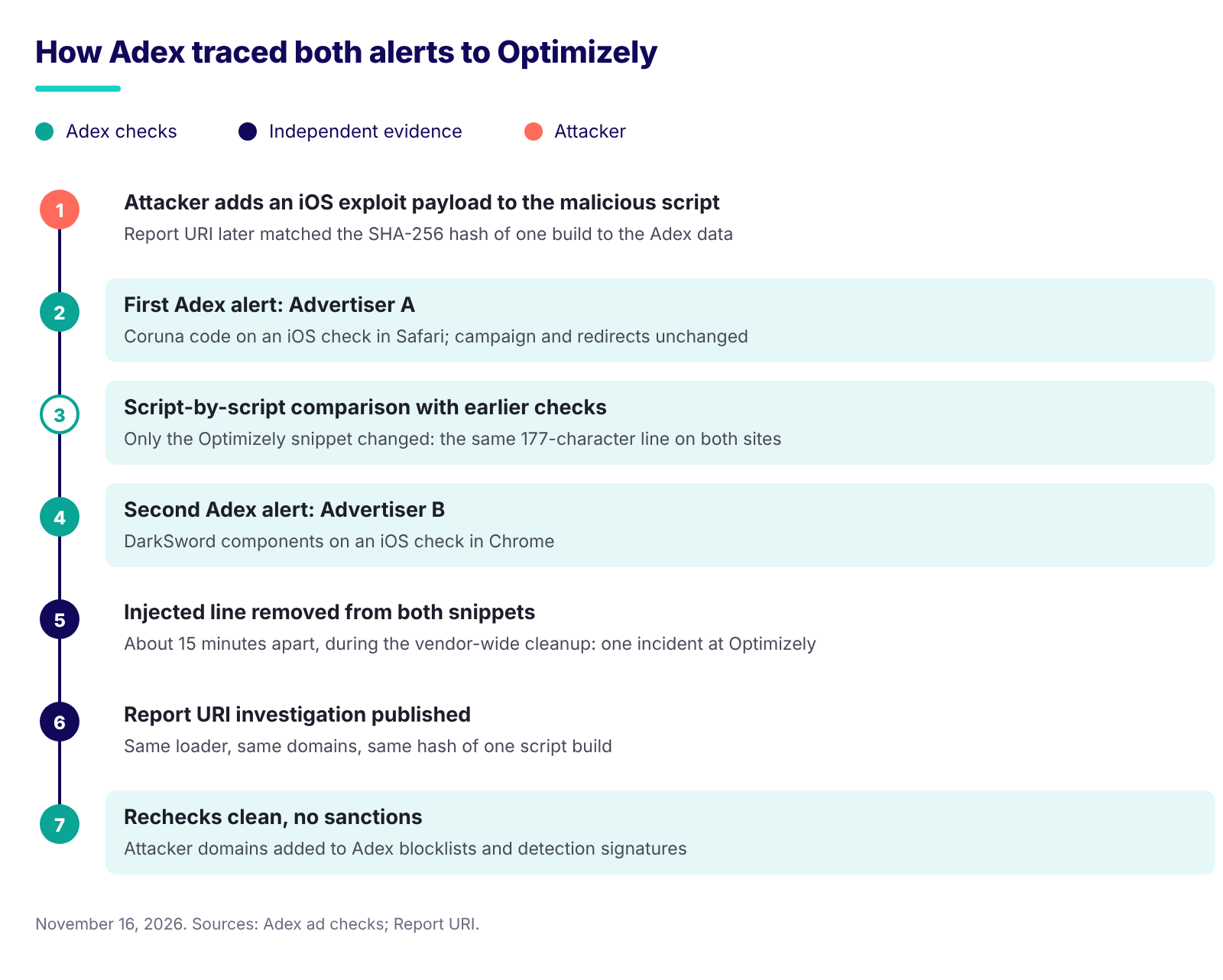
Something didn’t add up, so the Adex team went back through its earlier checks of both campaigns: the ads, redirects, and code served by the advertisers’ own servers were all clean and unchanged.
The Adex team went through the scripts one by one. On each page, just one file had changed. In both cases, it was the Optimizely script the brand used to run A/B tests. Someone had slipped the same piece of malicious code into both copies.
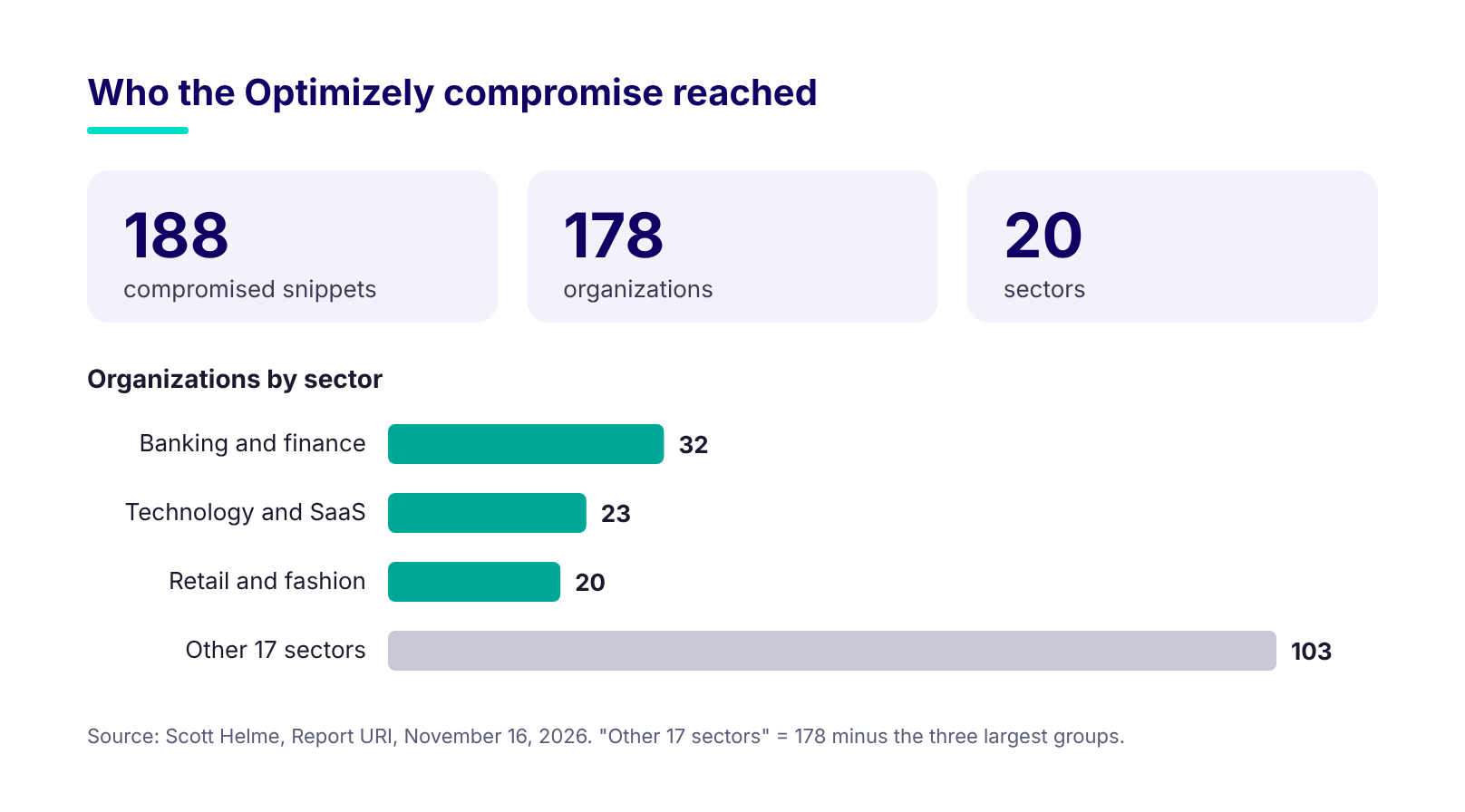
By the end of the night, Report URI’s investigation had found the same code in 188 Optimizely scripts used by 178 organizations.
Read on to see how the investigation has unfolded so far and what steps you should take immediately.
Contents
TL;DR
- A trusted advertiser’s landing page can start serving malicious code within hours, even when the campaign and the advertiser’s own code stay the same.
- On November 16, 2026, malicious code injected into Optimizely’s Project JavaScript field reached 188 scripts used by 178 organizations. Optimizely confirmed that the attacker exploited a vulnerability in its Experimentation product.
- Only iPhones and iPads received the iOS exploit code. A desktop or Android check of the same page would have missed that part of the attack.
- On iOS 26, Adex saw a DarkSword component get further than public reports had described. The team found no evidence of a working exploit on that version.
- Apple patched the known exploit chains in iOS 18.7.3 and iOS 26.3. Switching from Safari to Chrome on an iPhone generally offers no protection because both browsers typically use WebKit.
Why Adex Treated Both Advertisers as Victims
Before deciding what to do about either campaign, the Adex review team had to find out how the exploit code got onto the page. Had the advertiser put it there, or had someone compromised the page?
In both cases, the trail led back to a compromised Optimizely script the advertiser already used for A/B testing.
| Advertiser A | Advertiser B | |
|---|---|---|
| Who | Large international fashion retailer | Large European consumer brand |
| Check time (UTC) | November 16 | November 16 |
| Device and browser | iPhone, iOS 26, Safari | iPhone, iOS 26.7, Chrome |
| What loaded | Coruna exploit kit code (signature match, no successful exploitation) | DarkSword exploit kit components |
| Source of the injected code | Optimizely snippet: file comparison plus an archived copy | Optimizely snippet: file comparison and cleanup timing (no archived copy) |
| Recheck | Clean | Clean |
The comparison of earlier checks showed the same change on both sites. The Optimizely snippet on both sites had gained the same 177-character line that loaded the malicious script.
An independent web archive had saved a copy of the first advertiser’s Optimizely snippet that evening. It matched the file Adex had captured, byte for byte, including the injected line.
The added line disappeared from both snippets that evening, within about 15 minutes of each other. That timing was another clue that both sites were affected by the same incident at Optimizely.
The Report URI investigation later backed that up. The loader and domains matched, as did the SHA-256 hash of one build of the malicious script.
Since Adex traced the code to Optimizely, neither advertiser faced sanctions. The team added the attacker’s domains to its blocklists and set up checks to flag them if they turn up in another campaign.
Adex had seen a similar case in 2023, when a compromised copy of jQuery sent visitors through malicious redirects.

What Report URI and Optimizely Have Published
Optimizely Web Experimentation runs A/B tests through a snippet that each site loads from the vendor’s CDN.
Every project has a Project JavaScript field with custom code that runs on every webpage where the snippet loads.
On November 16, the attacker added a single loader line to that field in customer projects. The rest of each snippet was unchanged, and the files were still served from cdn.optimizely.com with a valid certificate, so browsers and most site security policies accepted them as normal vendor code.
Scott Helme’s investigation for Report URI, published on November 16, found 188 compromised snippets across 178 organizations in 20 sectors. Banking and finance accounted for the most organizations (32), followed by technology and SaaS (23) and retail and fashion (20).
The earliest injection Report URI found was at 04:21 UTC. The script initially swapped cryptocurrency wallet addresses on pages, in forms, and on the clipboard.
Starting at 13:43 UTC, the script also captured card numbers, expiration dates, and CVV codes that visitors typed directly into a website’s own forms. Card details entered in an embedded form hosted by a payment provider like Stripe were out of reach.
Whenever the script swapped a crypto wallet address next to text about wallets or payments, it also sent the attacker a screenshot of the page and any cookies that scripts on the page could read.
Later that afternoon, the attacker added a second server for the iOS payload. By 17:57 UTC, affected pages were serving Coruna to visitors on iOS 18.6 or earlier.
Report URI tracked 26 versions of the malicious script that day and saw about $7,040 reach the attacker’s wallets in roughly nine hours.
Most of the cleanup happened between 20:40 and 21:10 UTC. By 21:52, just one of the 188 snippets still carried the code.
Report URI also traced the same injection code back to an earlier wave that began on November 13 and spread through scripts from Kissmetrics, StorifyMe, and Minute Media.
At 01:02 UTC on November 17, Optimizely confirmed the breach and said it had fixed the vulnerability, removed the injected code, and secured affected accounts.
In a separate report for customers, the company said a flaw in the Web Experimentation signup process had let the attacker impersonate administrators and edit Project JavaScript in customer projects.
Optimizely’s report dates the first malicious edit to 07:51 UTC, about three and a half hours after the earliest injection Report URI recorded at 04:21. Neither source explains the difference.
How the Attack Reached the Browser
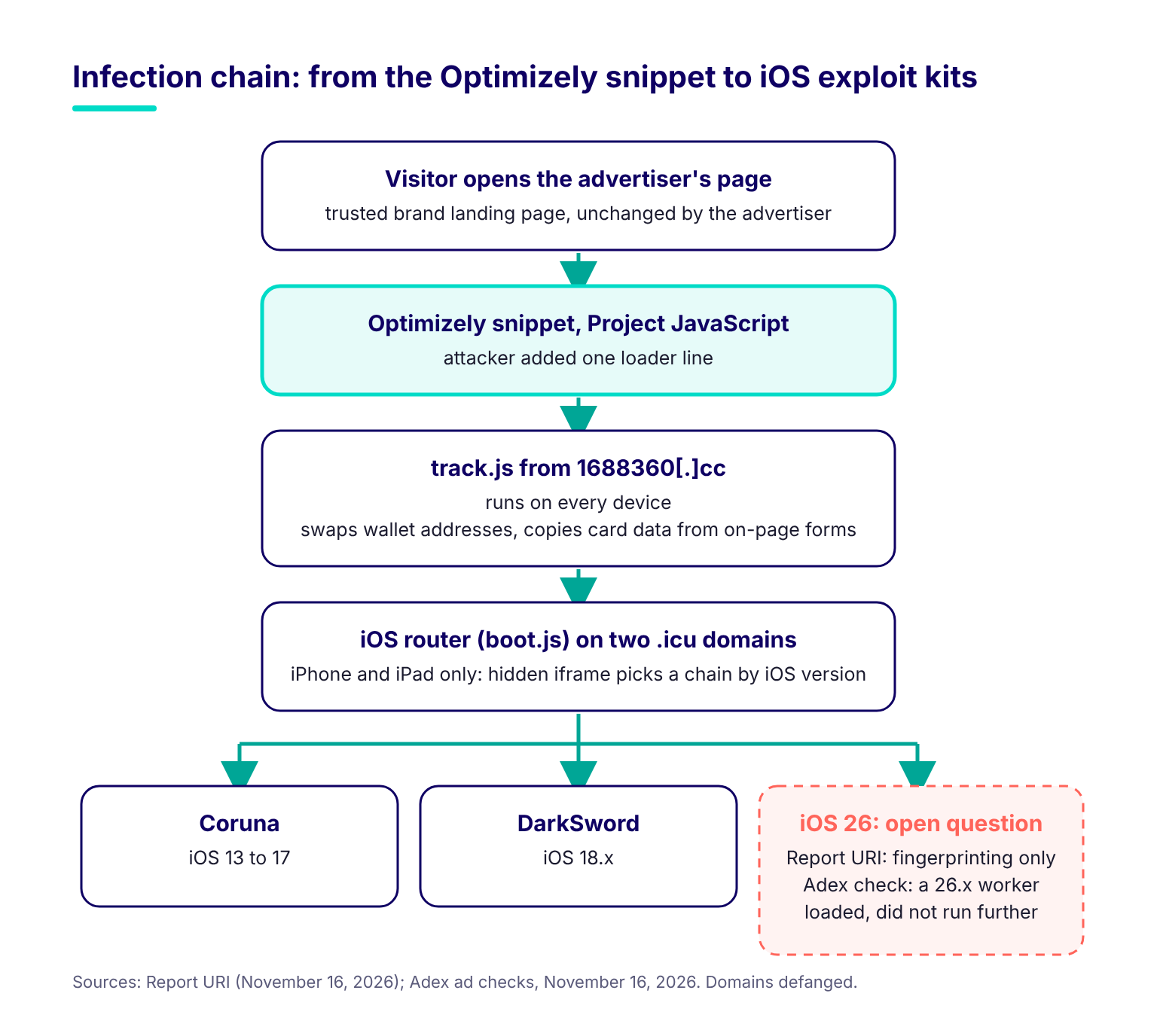
The modified Optimizely snippet loaded track.js, the wallet-swapping and card-skimming script described above, on every device that opened an affected page. On iPhones and iPads, it also loaded boot.js, which used the iOS version reported by the browser to pick what to load in a hidden frame. When the browser reported iOS 18.6 or earlier, the page reloaded every minute to try again.
That explains how Coruna ended up in the first Adex check.
The check ran with an iOS 26 browser profile, and Safari reported iOS 18.6 in its user agent. The script took that version at face value and served Coruna, a kit built for much older iOS versions. Coruna then checked the real version itself, found it unsupported, and stopped before loading an exploit.
In the second check, Chrome reported iOS 26.7. DarkSword’s loader identified that version correctly and marked it as unsupported, but still loaded an experimental variant, including a worker file for iOS 26.x that almost entirely matches an earlier DarkSword build for iOS 18.7, with changes limited to configuration. Adex’s analysis of the code suggests the attackers serve this variant to every newer iOS version to collect data and keep developing it. When Report URI checked the same iOS 26 branch, it saw the script collect device information and stop there. Neither kit got as far as a working exploit in the Adex checks.
Chrome on iPhone generally uses WebKit, the same browser engine as Safari. The fixes for the vulnerabilities these kits use come through iOS updates.
What This Means for Ad Review
A trusted advertiser’s landing page can start serving malicious code within hours. During the Optimizely incident, the affected pages served that code for much of the day while the advertisers’ campaigns, creatives, and sites stayed the same.
- Keep checking after launch. An ad review captures what the page serves at that moment. Any of the third-party scripts it loads can change while the campaign is live. Adex regularly rechecks live campaigns, and both pages came back clean on recheck.
- Check the page the way visitors see it. The exploit kits were delivered only to iPhones and iPads. A desktop or Android check of the same page would have missed the iOS code.
- Find the source before blaming the advertiser. An alert tells the review team what a page served. Tracing the code to its source helps the team protect visitors and decide what to do about the campaign. In this case, both advertisers were victims of the same attack as their visitors.
Adex is continuing to investigate how Coruna and DarkSword reach the landing pages that ads point to, and its rechecks of live campaigns now cover recent iOS versions on iPhone.
Adex is also adding checks for the way malicious code gets onto a page, such as an analytics or A/B testing tag that starts loading a script from a newly registered domain.
Steps for Site Owners and iPhone Users
If you run a site, start by checking which scripts your pages load and where those scripts can send data.
For site owners and advertisers:
- Check Project JavaScript and the custom code of every Optimizely experiment for unfamiliar external scripts, atob( calls (base64 decoding, which the attacker used in one loader version), and the domain 1688360[.]cc.
- Change passwords, API tokens, and integrations with write access to your tag, testing, and analytics services.
- Report URI advises treating card data typed into your own on-page forms on November 16 as potentially compromised. Hosted payment iframes were outside the skimmer’s reach.
- Restrict script-src and connect-src in your Content Security Policy, avoid ‘unsafe-eval’, and turn on violation reports. According to Help Net Security, citing Report URI, of the affected organizations whose policies Report URI could classify, 24 (about 15%) had a policy strict enough to block the attack, and 68 had none.
- Set up alerts for changes in third-party files your pages load.
As commenters pointed out in the Hacker News discussion, Subresource Integrity lets your site load only the version of a script it expects, but every time Optimizely updates your copy of the script, you’d have to update that check too.
According to Report URI, CSP helped the 24 organizations because their script-src was restrictive and did not allow the attacker’s domains, but a policy that allows cdn.optimizely.com cannot block a payload delivered inside the vendor’s own file. An alert on changes to that file would have flagged the injected line.
For iPhone and iPad users:
- Install the latest update your device offers. Go to Settings → General → Software Update. Report URI identified 18.7.3 and 26.3 as patched versions for the kits used in this attack. Google confirmed that 26.3 fixes all six known DarkSword vulnerabilities and recommends turning on Lockdown Mode if you can’t update.
- Double-check pasted wallet addresses. Before sending crypto, compare the pasted address with the original, character by character.
- Check your card statement. If you paid by card on an affected site on November 16, look for charges you don’t recognize. If you spot one, call your card issuer right away and ask them to block and replace the card.

Indicators of Compromise
The indicators below were recorded by the Adex checks and match the public investigation. Domains are defanged on purpose. Report URI’s write-up carries the full list, including wallet addresses and additional domains.
| Type | Value | Role |
|---|---|---|
| Domain | 1688360[.]cc | Hosts track.js; receives stolen card data, cookies, and screenshots |
| Domain | 5vobauua3ojpklx[.]icu, eil786npto9u5bq[.]icu | iOS router (boot.js) |
| Domain | ios-hack[.]icu | Fallback command server |
| Script attribute | data-channel-code=”02111110″ | Attacker’s campaign identifier |
| SHA-256 (track.js) | f7b84b9a94f749f8ced3f0112d0a66894e8bbc3b4aa5592021d1b8976a9bad40 | 17:57 UTC build |
FAQ
On November 16, 2026, an attacker inserted a loader line into the Project JavaScript field of Optimizely Web Experimentation projects. The vendor’s CDN then served the modified snippets to visitors of 178 organizations, and the loaded script swapped wallet addresses, captured card data from on-page forms, and sent iPhone visitors into iOS exploit kits. Optimizely says the attacker exploited a vulnerability in Experimentation that has since been fixed.
No evidence points that way. The code arrived through a vendor script, and the advertisers’ own code and campaigns were unchanged, so they were victims of the same attack as their visitors.
No. Chrome on iPhone generally uses the same WebKit engine as Safari, and one of the Adex checks in this case reached the chain in Chrome. The protection that works is an iOS update.
iOS 18.7.3 and iOS 26.3 and later. According to Report URI, the attacker’s own code comments treat these versions as patched, and Google lists all 6 DarkSword vulnerabilities as fixed by iOS 26.3. Coruna works on iOS 13.0 through 17.2.1, according to Google, even though the attacker’s script served it to any device reporting iOS 18.6 or earlier.
What Remains Unknown
Two parts of the incident are still open. Optimizely has explained the flaw in its signup process, but it has not said how many projects were changed and is confirming the impact with each customer directly.
The iOS 26 branch is also unresolved: Report URI saw it only collecting device information, while the Adex check recorded a worker that almost entirely matches an earlier DarkSword build.
Adex is continuing that analysis and will update this case.